
TL;DR
Cash back is not the naive choice. A flat 2% card pays the same rate on everything and a dollar of it is always a dollar. Points do turn into money, but American Express pays 0.6 cents per point when they do, which is where the points-are-always-better argument breaks. The question is not points instead of cash back. It is points where the multiplier clears the cash floor, cash back everywhere else, and knowing how the two work together.
The cash back crowd is right about the important part
The Citi Double Cash Card pays 2% on everything with no annual fee and no categories to track. On $24,000 of annual spending that is $480, and it is $480 whether you travel or not.
That is the case for cash back, and it is strong. A points balance is worth only what you convert it into, and conversion takes intent. Cash back has no conversion step. If your goal is pure savings, that certainty is worth real money.
But a point is not a fixed unit
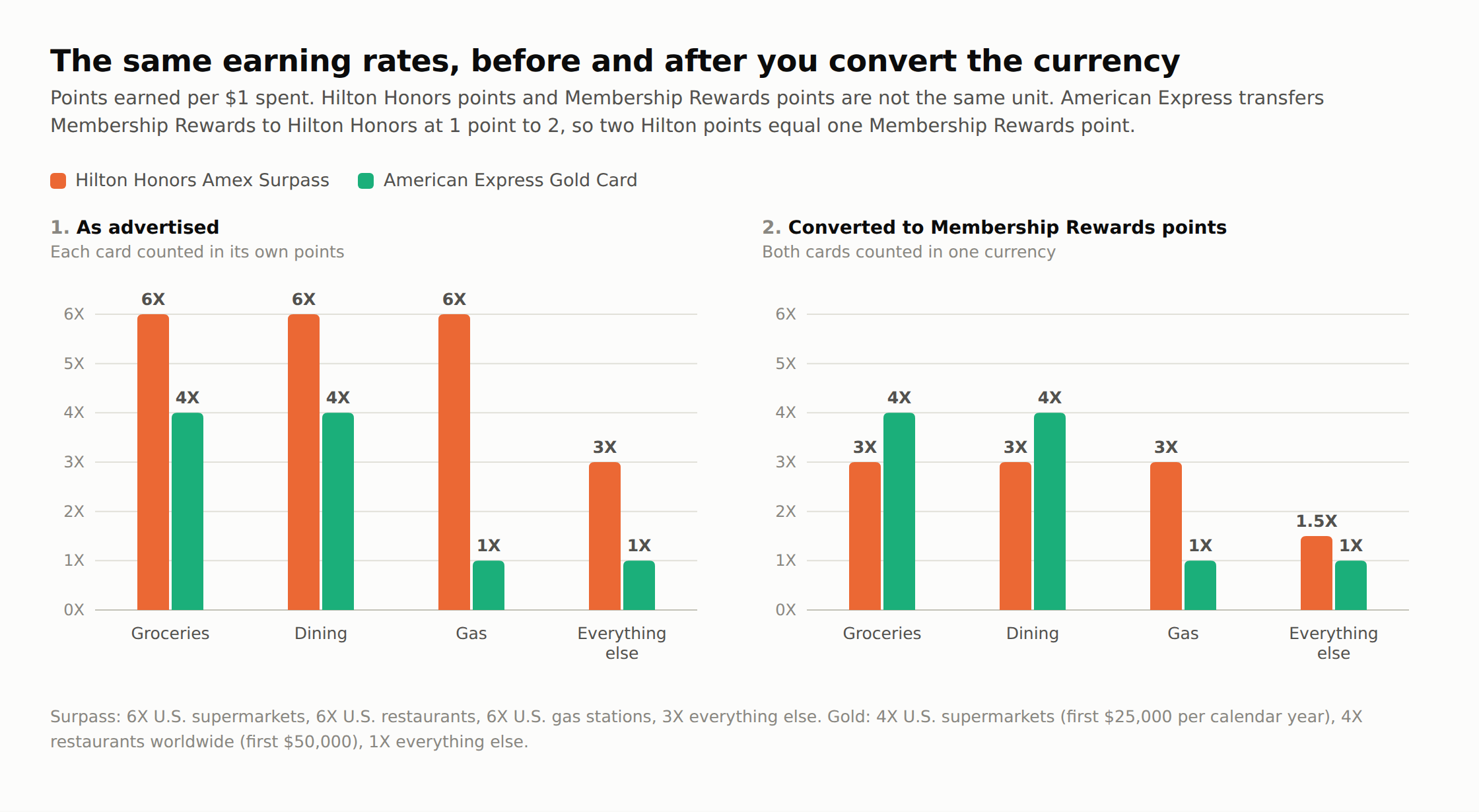
Here is where co-branded cards get people. The Hilton Honors American Express Surpass Card advertises 6X at U.S. supermarkets. The American Express Gold Card advertises 4X. Six looks better than four.
They are different currencies. American Express moves Membership Rewards points into Hilton Honors at 1 to 2, so one Membership Rewards point becomes two Hilton points. Divide the Surpass rate by two and its 6X is 3X in Membership Rewards terms, against the Gold's 4X.
Pressure test: points do turn into money
The obvious objection is that points are money if you want them to be. True, and the exact rates matter. American Express publishes what it pays for its own points.
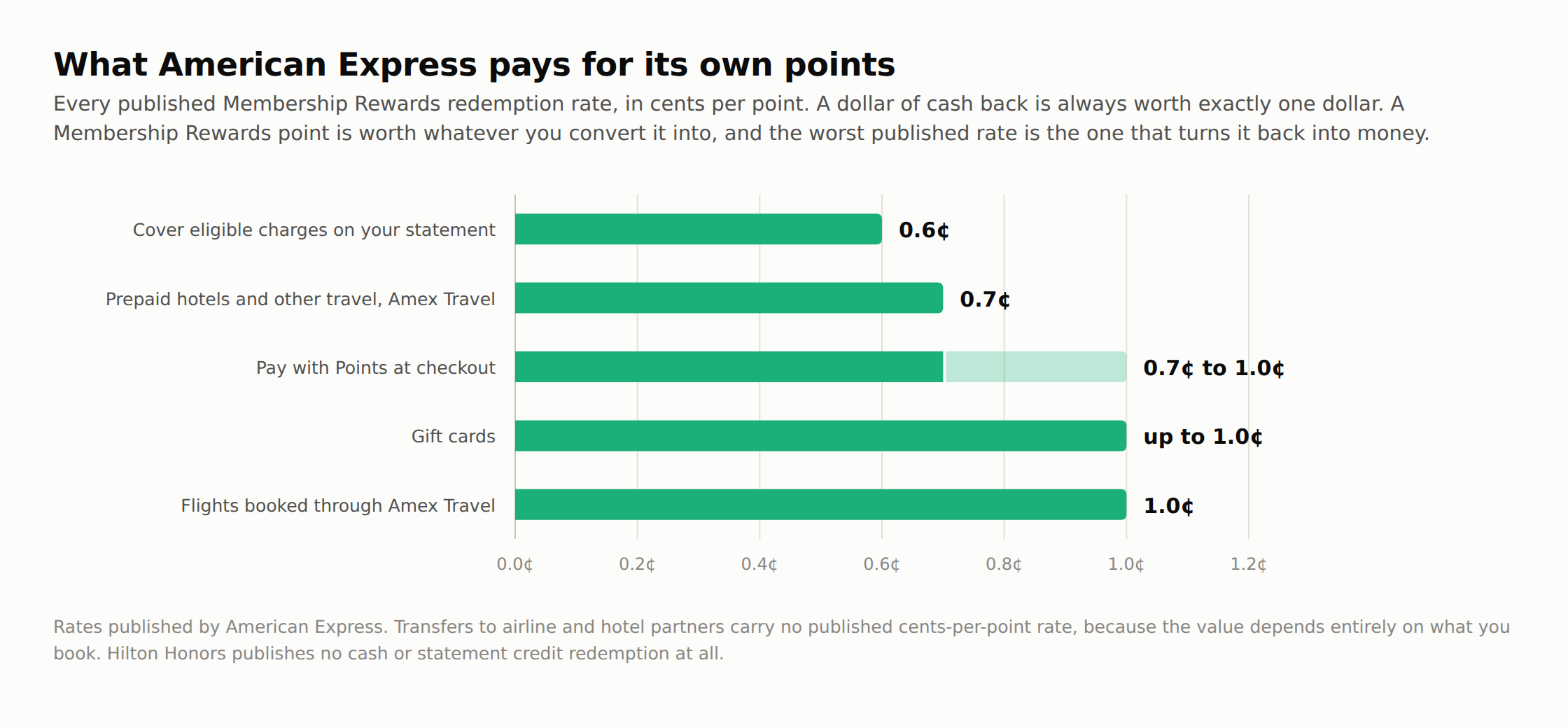
Note what is not on that list. There is no cash redemption and no bank deposit. The closest thing is covering an eligible charge on your statement, at 0.6 cents per point. Book a flight through Amex Travel instead and the same point is worth 1 cent, which is 67% more.
So the objection survives, but at the worst rate on the board.
Hilton Honors is the harder case. Its redemption page lists free nights, experiences, Lyft rides, Amazon purchases and car rentals, and none of them is money.
Run it per dollar
Take the Gold's 4X at U.S. supermarkets. At the 0.6 cent statement credit rate that is 2.4 cents per dollar, at the 1 cent flight rate it is 4 cents. Both clear a flat 2%.
Now take its 1X on gas and general spending: 0.6 to 1 cent per dollar, against 2 cents. Not close.
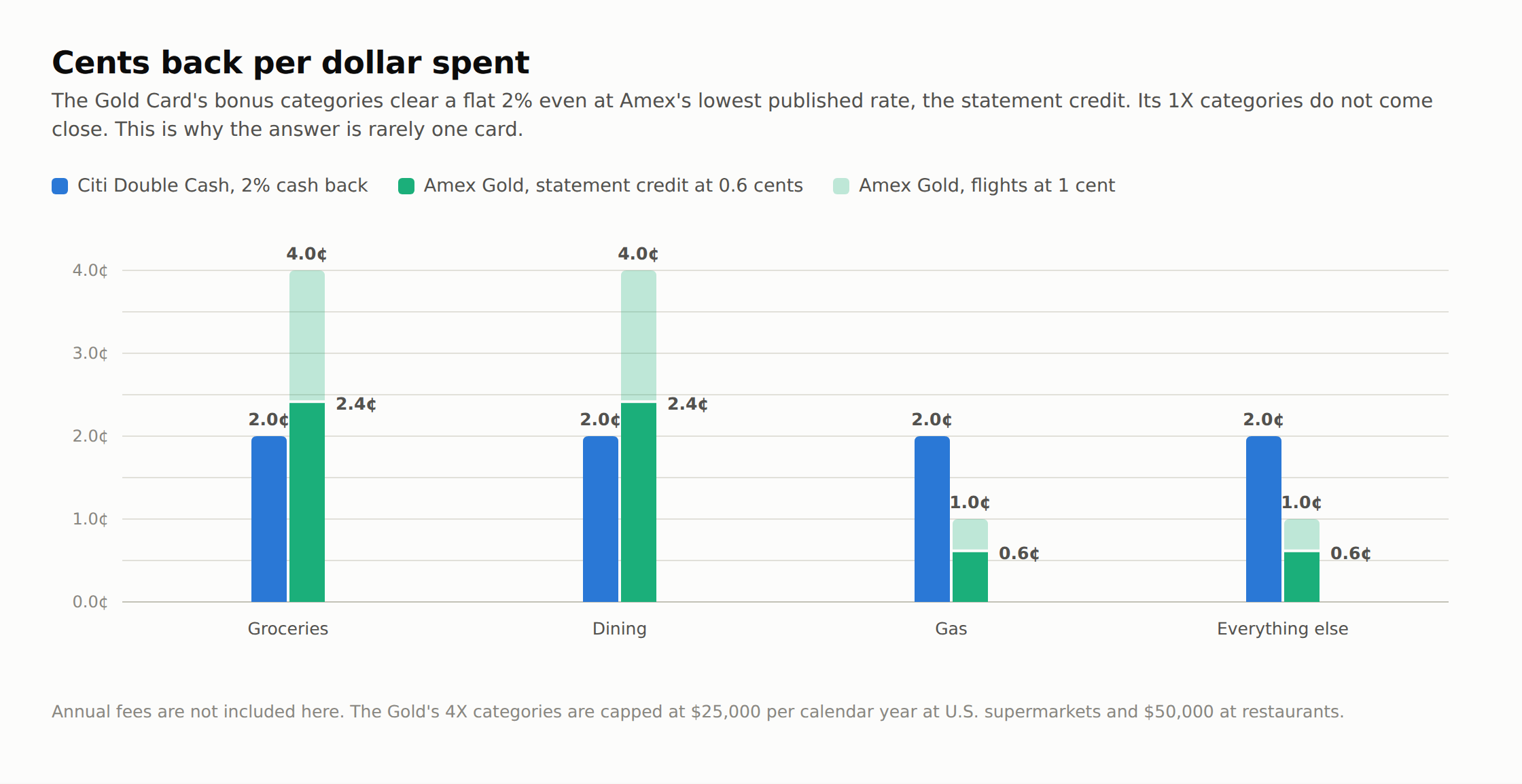
That is the finding, and it is not a verdict on either card. It is a verdict per category.
The fee is the real gate
The Gold charges $325 a year. The Double Cash charges nothing.
On supermarkets and restaurants the Gold beats a 2% card by 2.0 percentage points at 1 cent per point, and by 0.4 percentage points at the statement credit rate. That sounds survivable until you add the caps: 4X stops at $25,000 per calendar year at supermarkets and $50,000 at restaurants.
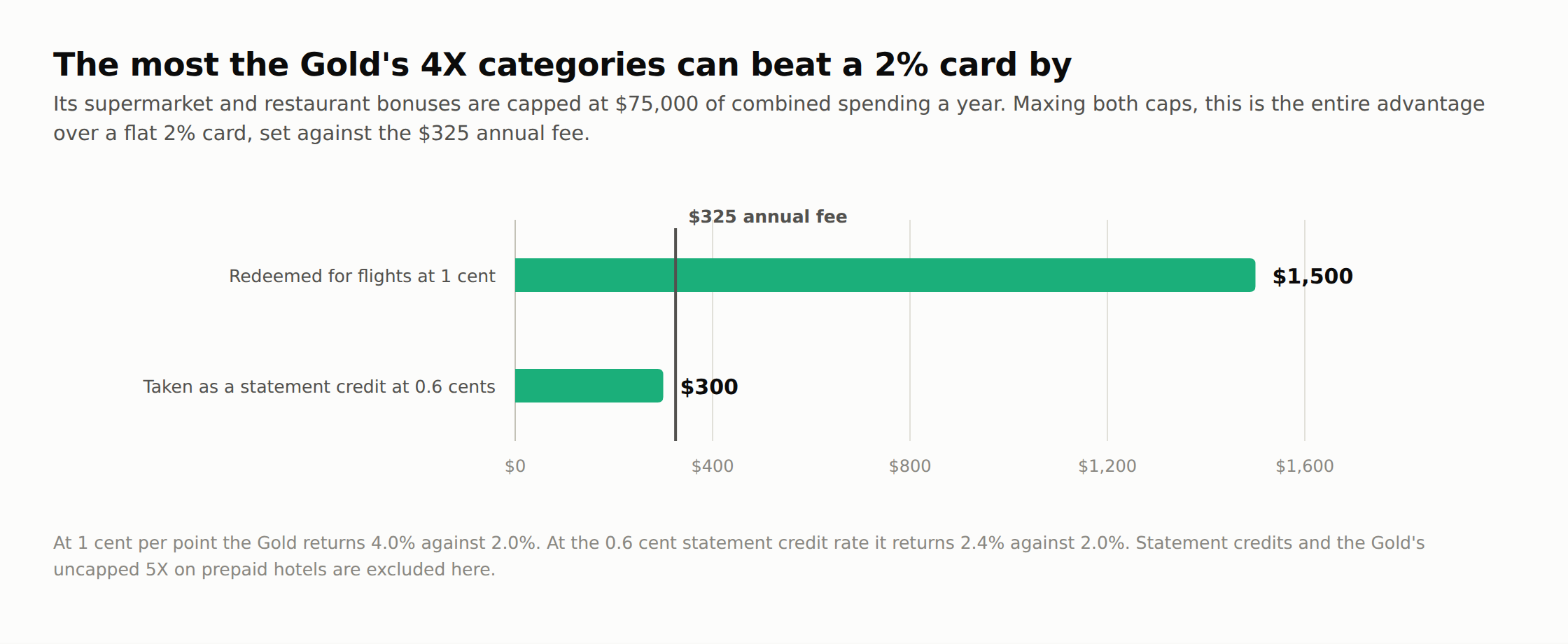
Spend every dollar of both caps, $75,000 in a year, and at the statement credit rate the Gold beats the 2% card by $300. The fee is $325. There is no spending level at which the Gold's 4X earning pays for its own fee if statement credits are your exit, because the caps close before the math does.
At 1 cent per point the picture reverses. $16,250 across the two categories covers the fee, and maxing both caps produces $1,500 of advantage against that $325.
The Gold's statement credits change this. Up to $10 a month on dining, up to $7 a month at U.S. Dunkin' locations, up to $50 twice a year at Resy restaurants and $10 a month in Uber Cash comes to $424 a year, counting only purchases you were making anyway. If those fit your life, the fee is covered before the earning rate is in play.
Who this affects
Anyone who has decided cash back is simply better, and anyone who took a hotel co-brand because the multiplier looked enormous.
If you never redeem for travel, a flat 2% card should be your main card, and a $325 annual fee is hard to justify on earning alone. That is not a concession. It is the math.
What a points card adds is not a higher rate. It is a wider set of exits. Cash back has one on its own, always at full value. Points have several, one worse than cash back and several that can be better. You are buying options with an annual fee, and options only pay if you use them.
The pairing most people miss
Cash back and points are not always different cards. On several issuers they are the same card, before and after you add a second one.
TPP's catalog records the Chase Freedom Unlimited and the Chase Freedom Flex as pairing with the Chase Sapphire Preferred and the Chase Sapphire Reserve: cash back becomes transferable points and the balances pool into one. The Citi Double Cash Card used throughout this article pairs the same way with the Citi Strata Premier Card, with points pooling to the Strata Premier and transfer partners unlocking. Capital One SavorOne pairs with the Capital One Venture X Card.

Read that against the earlier math. The flat cash back card is not a dead end that a points card replaces. It is the earning engine, and the annual-fee card is the exit door. You do not switch from one to the other. You add the second one when you have a use for what it opens up.
Which moves the question one last time. It is not whether points beat cash back. It is whether the card already in your wallet has a partner that would turn the rewards you are already earning into something with more ways out.
One honest limit, and TPP applies it the same way. Paired value is real only when you hold both cards. A pairing you do not own is not value you have, so TPP counts it inside your own wallet and never in general card rankings. When you add your cards, the pairings you actually hold are already part of the value TPP shows you and part of the playbook it keeps for you.
What to do about it
Ask which card wins each category, not which card is better.
Supermarkets and restaurants go on the Gold, which beats 2% in both even at the statement credit rate, up to the caps. Past $25,000 at supermarkets and $50,000 at restaurants the Gold drops to 1X and the 2% card wins those dollars too. Gas, bills and everything else go on the flat 2% card from the start. Travel is the one coin flip: the Gold's 2X ties a 2% card at the 1 cent rate and loses at the statement credit rate, so your redemption plan decides it.
If your wallet is Chase or Citi rather than Amex, run the same test with your own pairing. The bonus card takes the categories it wins, the flat card takes everything else, and the partner card is what decides how much the pooled points are finally worth.
Then be honest about the exit. If you know you will take statement credits, skip the annual fee and let the 2% card do all of it.
The fine print
Redemption rates and transfer ratios are set by American Express and change, so check them before planning around a number. The 1 cent flight rate is not a ceiling: a transfer can beat it or fall short, depending on the booking. The Double Cash's 2% is paid as 1% when you buy and 1% as you pay. Some benefits on both cards require enrollment.
For more articles like this one: follow The Points Pro on Facebook.