
TL;DR
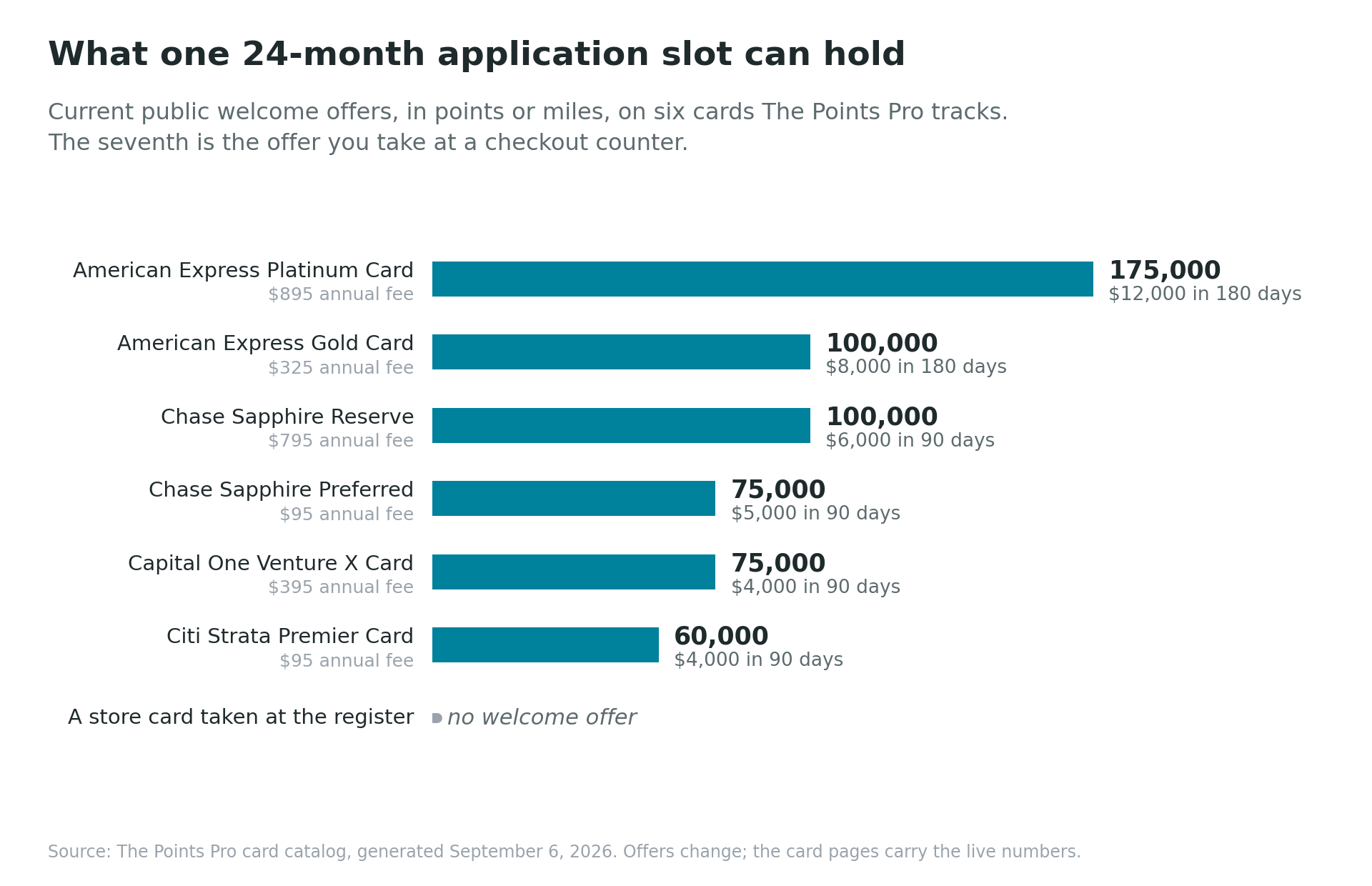
Every card you open spends something scarcer than credit: eligibility. Chase will not approve you once five or more new personal card accounts sit on your credit report inside a 24 month window, and the store card you took for 15% off at a register can be one of the five. The six consumer cards charted below carry public welcome offers of 60,000 to 175,000 points. A checkout counter offer carries none. Business cards mostly sit outside the count, and a 0% APR card sits squarely inside it.
The wallet is the product
Americans hold 636.6 million open credit card accounts, an average of 3.7 active cards each, against $1.246 trillion in balances, according to Experian's March 2026 figures. That is a mature market. Nobody is waiting to be sold their first card.
So the fight is not for new customers. It is for position inside a wallet that is already full.
Look at what the top of that fight costs an issuer right now. The American Express Platinum Card charges $895 a year and pays 175,000 points for $12,000 of spending in 180 days. The Chase Sapphire Reserve charges $795 and pays 100,000 points for $6,000 in 90 days. Those offers are not generosity. They are the price of a slot, and the issuer expects to earn it back over years of interchange, annual fees, and the sheer inconvenience of you ever switching.
Understanding what those points are actually worth is a separate exercise. The point here is simpler: a bank will pay a great deal to be the card you reach for, which tells you the slot is worth something. It is worth something to you too.
Every card you open spends the next one
The resource that runs out is not your credit limit. It is your application eligibility, and it is governed by rules that are not printed on any application.
The strictest one belongs to Chase. Chase has never published it, but the version documented consistently across years of cardholder data is this: five or more new personal credit card accounts opened in the past 24 months, at any bank, and Chase declines. Closing an account does not remove it. The clock is the opening date, and it runs whether or not you wanted the account.
Which means the budget gets spent by things that were never rewards decisions at all.
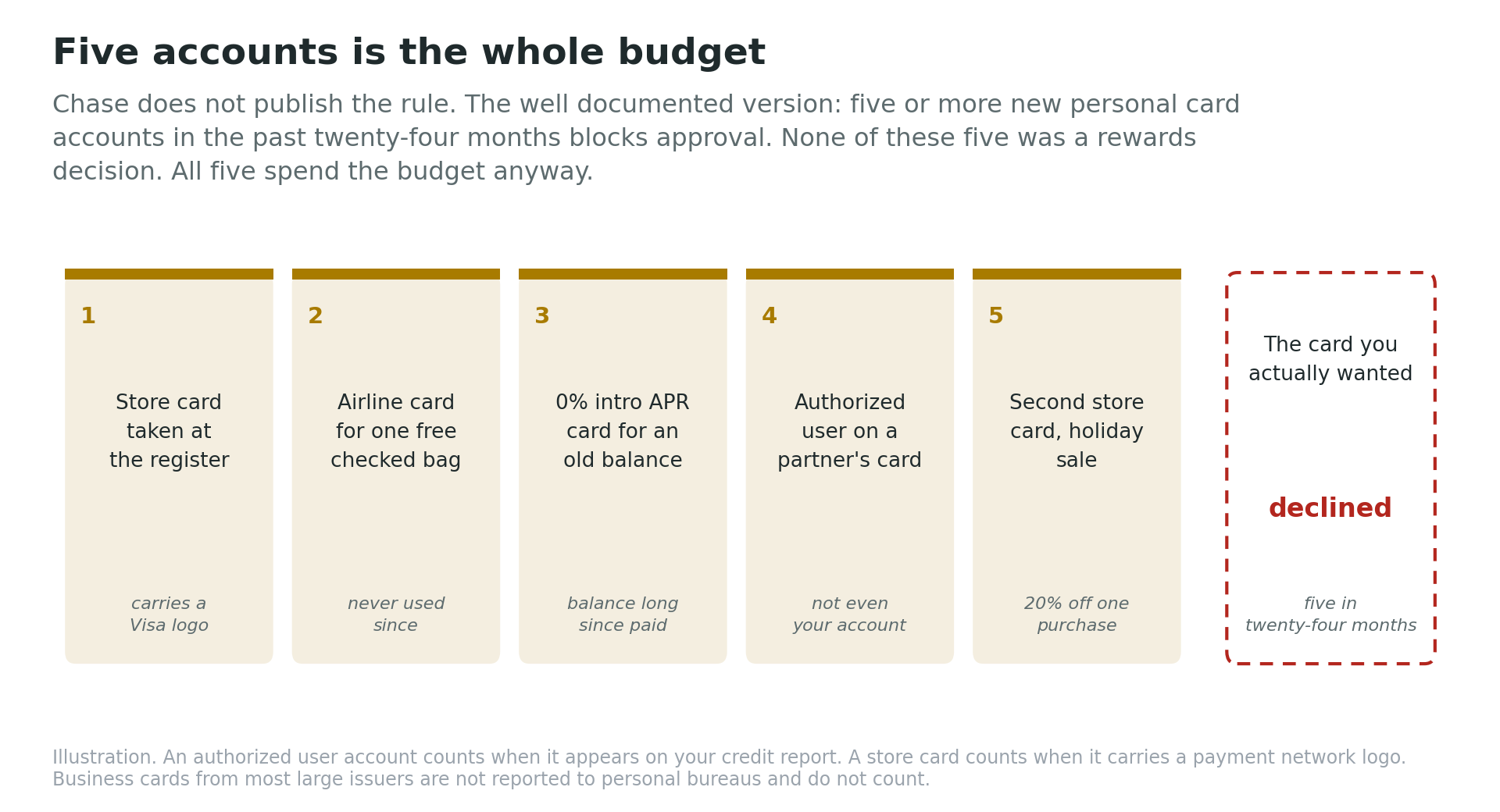
An authorized user account counts when it shows on your report, so being added to a partner's card can cost you a slot on an account that is not even yours. A store card counts when it carries a payment network logo.
None of that is exotic. It is an ordinary two years of ordinary life.
The rules that turn a slot into a hard limit
Chase is the strictest, but every issuer runs a counter of some kind. These are the ones worth knowing before you apply anywhere, and knowing them is most of what decides the order you apply in:
- Chase. Five new personal accounts in 24 months blocks approval. Roughly two personal cards per 30 days is the practical velocity ceiling. A bonus on the same card generally requires 24 months since the last one.
- American Express. The welcome offer on a given card is once per lifetime. The terms language is "Welcome offer not available to applicants who have or have had this Card," and closing the card does not reliably reset it. Family restrictions apply across the Platinum, Gold, and Green tiers. Two credit cards per 90 days, and five Amex credit cards held at once, though charge cards sit outside that count.
- Citi. A 48 month clock per card since your last bonus on it, judged per product. One approval every 8 days, two every 65 days.
- Capital One. A 48 month clock on the same product, with cross restrictions inside the Venture family.
- Bank of America. Two cards in 2 months, three in 12, four in 24.
- Wells Fargo, Barclays, US Bank. Each runs its own new-account ceiling, generally in the same shape.
Read that list again with one question in mind: which of those clocks is currently running because of a card you actively wanted? For most people the honest answer is one or two of them.
The one real exception: business cards
Everything above counts personal card accounts. That word is doing a lot of work.
Most large issuers do not report a business card to your personal credit report at all. Amex, Bank of America, Barclays, Chase, Citi, US Bank and Wells Fargo all state that they do not, and years of cardholder data agree. Capital One, Discover and TD Bank do report business cards to personal bureaus, with some exceptions inside Capital One's range. So for the majority of business cards, the account never appears in the file that Chase, Bank of America or Wells Fargo are counting, and it does not spend a slot.
That is why people who do this seriously open business cards first and personal cards second. It is the only genuine pressure valve in the system, and it is not a loophole. It is how the accounts are classified.
It is also not a free pass. Four things it does not exempt you from:
- The hard inquiry is personal. The application still pulls your personal credit report, whatever happens to the account afterwards.
- Chase still looks at 5/24 when it decides a business card application. A Chase business card does not add to your number, but being over the line still gets the business card declined. Business cards keep the count from rising. They do not rescue you once you are already over it.
- Citi counts business approvals in its velocity limits. The one card every 8 days and two every 65 days include business cards.
- Bonus restrictions are per product, not per card type. American Express applies its once per lifetime language to business cards, and Citi's 48 month clock runs on a business card the same way it runs on a personal one.
On qualifying: you do not need a corporation. Chase's own guidance notes that many issuers let sole proprietors apply, sometimes using a Social Security number instead of an EIN, which covers freelance, consulting, resale and gig income. The same page warns that inaccurate or incomplete information on an application can get it rejected. Apply with your real activity and your real numbers, or do not apply.
The store card at the register
The offer arrives at the worst possible moment for clear thinking. You are holding merchandise, there is a line behind you, and the discount is real. Half of all retail card applications are submitted in person, which is to say at a counter, per the Consumer Financial Protection Bureau's December 2024 review of the retail card market.
Here is what that card is, financially.
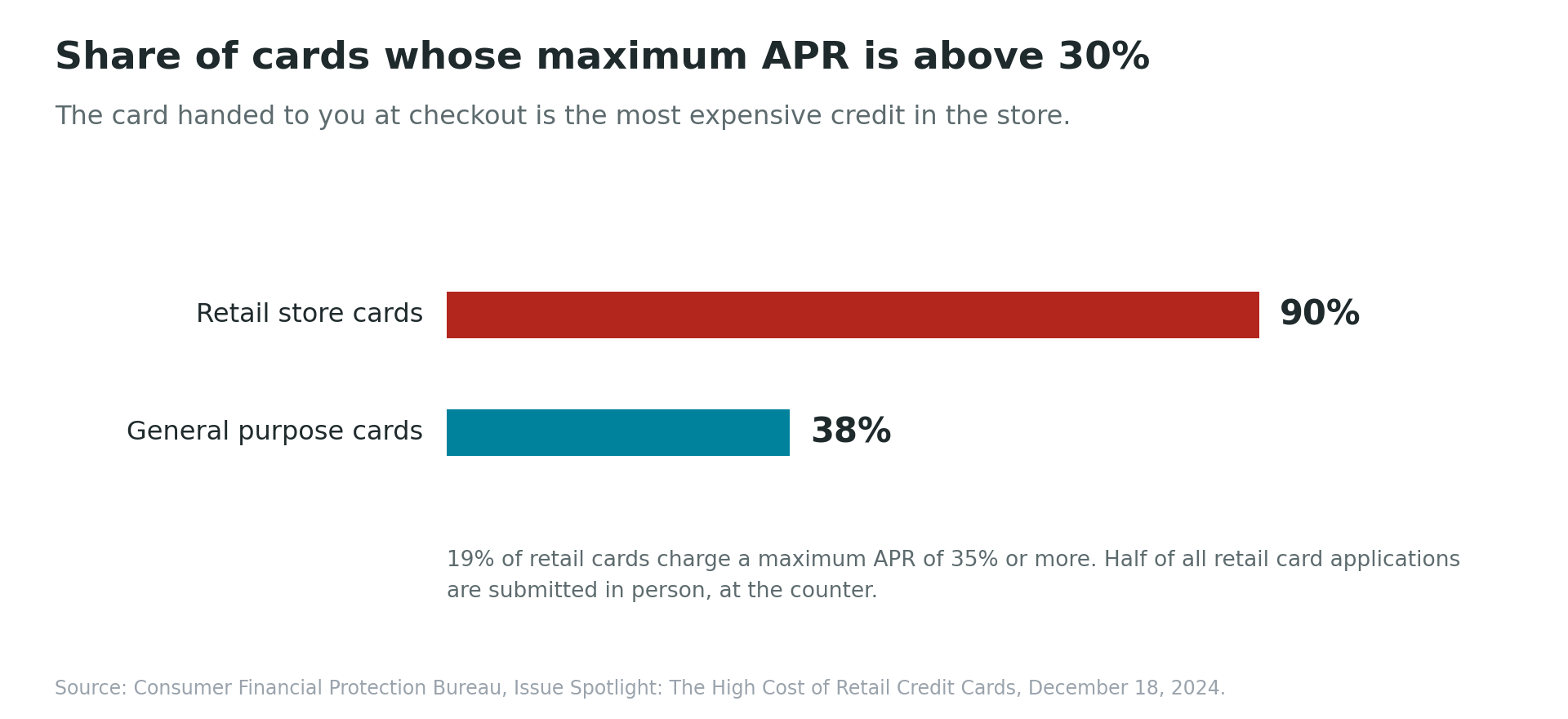
Ninety percent of retail cards carry a maximum APR above 30%. For general purpose cards the figure is 38%. Nineteen percent of retail cards charge 35% or more. The average retail card APR was 32.66%, against roughly 20.94% for all commercial bank credit card plans in May 2026 per the Federal Reserve. The card handed to you at checkout is, as a category, the most expensive credit sold in the building.
Then there is deferred interest, which is the retail card's signature product and is not the same thing as 0% financing.
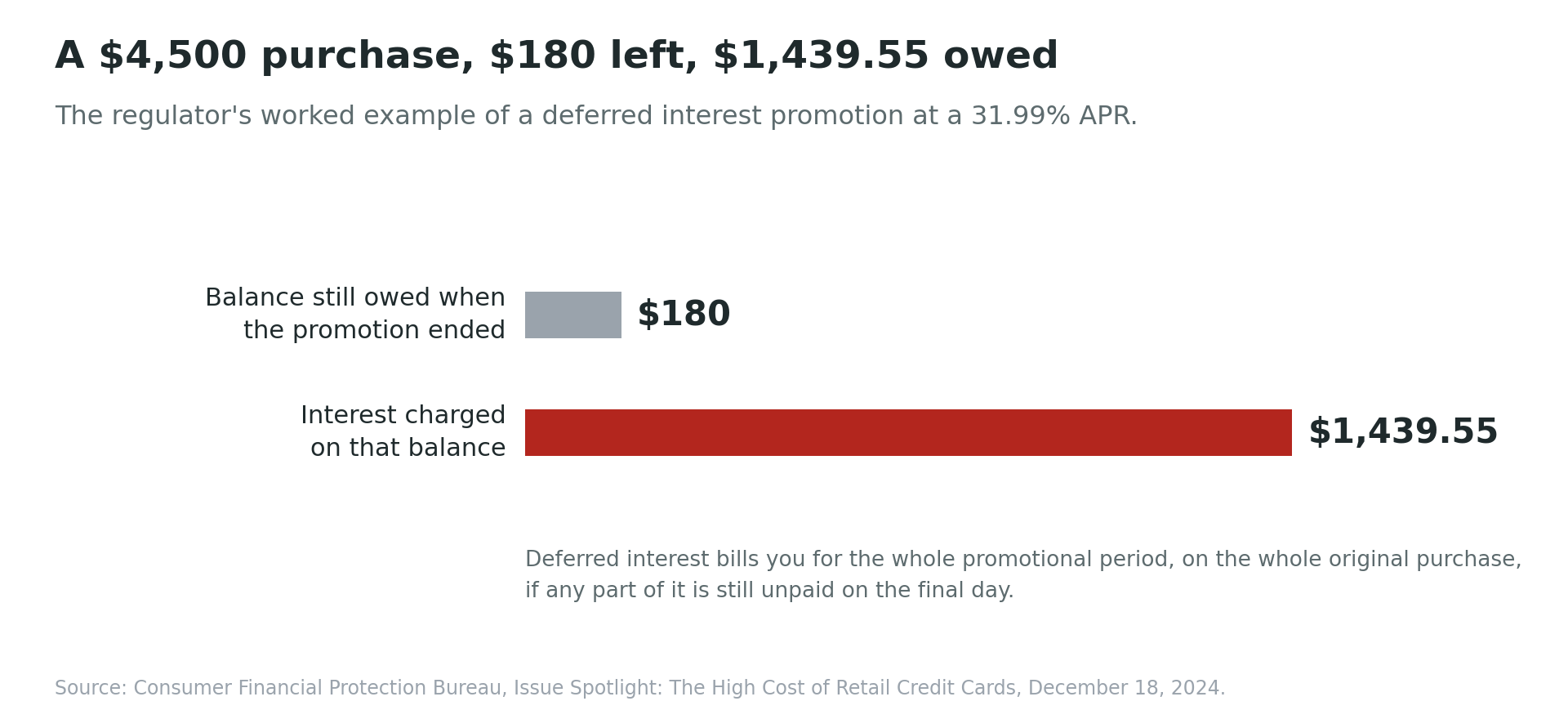
The CFPB's worked example: a $4,500 furniture purchase on a deferred interest plan, $180 still owed on the final day of the promotional period, and $1,439.55 in interest charged at a 31.99% APR. Not interest on the $180. Interest on the whole original purchase, for the whole promotional period, retroactively, because a balance existed at the deadline.
Whether that card also costs you a Chase slot depends on the logo. The documented read is that a card usable only at one store does not count, while one carrying a Visa, Mastercard, American Express, or Discover logo does. Coverage is not unanimous on this, so treat a store-only card as a maybe rather than a free pass. And the split matters less than it sounds, because the store cards pushed hardest at registers are increasingly the network-branded kind, precisely so you will use them everywhere.
Even in the best case the card is a hard inquiry, a new account dragging down the average age of your credit, and a line you now have to keep open indefinitely to avoid making that average worse. The discount was 15% of one purchase.
If you are starting from zero, this section is for you
There is an obvious objection to everything above, and it is a fair one. If you have no credit file, the store card may be the only thing that will approve you. Its limits are low, its standards are forgiving, and it reports to the bureaus. That is a real path.
The CFPB agrees, and it is worth saying so plainly rather than pretending otherwise. Its guidance on starting or rebuilding a credit history lists three routes: a secured credit card, a credit builder loan, and a retail or store card, and it notes that the low limits on store cards help keep the damage small while you build a record. Taking one is not a mistake.
The question is what the slot buys you, because the slot costs the same either way.
A secured card is the most used of the three. Federal Reserve research published in December 2024 found secured cards make up 76% of credit-building accounts and 58% of the balances, with 2.3 million accounts open as of the first quarter of 2024, at a median deposit of $325. You put money down, you spend against it, and the account reports exactly like any other card.
What happens next is the part that matters. Research from the Federal Reserve Bank of Philadelphia found that about 20% of secured card accounts graduate to an unsecured card, and that the graduation clock has shortened sharply: the 2012 cohort took 61 months to reach that 20% mark, the 2017 cohort took 11 months. On graduation the security deposit is refunded in full. For people who started with no score at all, the ones who graduated reached a median score of 687 against 634 for those who did not, and roughly a quarter of them reached 728 or better. Either group took about six months to get a first score at all.
Set that against a store card, which does not graduate into anything. Two years on it is still a store card, still priced above 30%, still usable at one retailer, and you still have to keep it open forever so your average account age does not drop when you close it.
Two honest caveats. Graduation is not guaranteed, and the Philadelphia Fed found issuers handle it two different ways: some convert the same account, which keeps its age, and some close the secured account and open a new unsecured one, which starts a fresh age. Ask before you assume. And a secured card spends a slot on the same 24 month clock as everything else, so this is not a way around the arithmetic. It is a better use of the same square of space.
Whichever you take, the mechanic that builds the file is the same and it is dull: one small recurring charge, paid in full, on autopay. The CFPB's own summary of what works is "paying on time, every time." Nothing about the card's brand changes that.
The 0% APR card: the honest answer
This is the case where the conventional points advice and the correct advice diverge, so it is worth being exact.
If you are carrying a balance at 20.94%, or at a retail card's 32.66%, then rewards are not your problem. A 2% cash back card earning 2% while you pay 20.94% is losing 18.94%, and no welcome offer in the chart above closes that gap on an ongoing balance. Moving that balance to an intro APR card and killing it is the right move, and it is the right move even though it costs you a slot. That is the whole of why interest kills rewards, and the order of operations is not negotiable: the debt first, the game second.
What deserves saying, and what most balance transfer advice leaves out, is that "0%" describes one rate on one balance. It does not describe the price of the card. There are six costs.
It charges a fee on day one. A balance transfer fee is a percentage of the amount you move, added to the balance immediately, and the CFPB confirms an issuer is allowed to charge it on a zero percent offer. At an example rate of 3%, moving $6,000 costs $180 before you have saved anything. That is usually still worth paying, because the same $6,000 sitting at 20.94% costs about $105 in the first month alone. Pay it with your eyes open, and check the actual rate in the card's own terms rather than assuming.
It stops being 0% for anything else you buy on it. This is the cost almost nobody mentions, and it is the one that turns a rescue into a trap.

The CFPB states it flatly: "if you carry a balance month to month, any purchases you make will accrue interest from the date of the transaction. This is true even if another balance you are carrying is not subject to interest because it was a 0% balance transfer." The transferred balance keeps its promotional rate. Your grace period on new purchases does not survive it.
Now notice how these cards are marketed. Many of them are also everyday cash back cards, with rotating categories and a rewards rate on the front of the offer. That combination is not an accident. Used the way the marketing suggests, you earn 2% on a purchase and start paying roughly 21% on the same purchase from the day you make it. The card that was supposed to dig you out becomes the card you are adding to.
Only part of your payment fights the expensive balance. Regulation Z requires the amount you pay above the required minimum to go to your highest rate balance first. But the rule explicitly does not govern the minimum payment itself, which the issuer allocates as it likes. Pay only the minimum on a card holding a 0% transfer and a pile of new purchases, and none of the structure is working for you. Paying well above the minimum is what makes the law help.
It is a deadline, not a solution. When the promotional window closes, whatever is left reprices to the go-to rate, and the balance you were managing becomes the balance you were running from. The test is arithmetic, and you should do it before you apply: take the balance, add the transfer fee, divide by the number of promotional months. That number is your payment. If you cannot make it, the transfer is postponement, not repair, and the pile grows while you feel like you are handling it.
It spends a slot. The intro APR card is a new personal credit card account. It sits in the same 24 month window as everything else, and it will still be sitting there when you are debt free and ready to apply for the card you actually want.
It can burn a welcome offer permanently. With American Express the welcome offer on a specific card is once per lifetime, and taking that card for its intro rate spends the offer whether or not you ever received a bonus. If the intro APR card you pick happens to be one you would have wanted the bonus on later, you have traded a five-figure offer for a promotional rate.
It moves your utilization. Average card utilization in the US sits at 28.3%. Concentrating a balance onto one new account can push that account near its limit, which pressures your score, which is the same score the next issuer reads.
None of that changes the verdict. Pay the interest down first. But take the card deliberately: pick an issuer whose cards you are not planning to apply for next, put nothing new on it, set the payment that clears it before the clock does, and know which counter you just started.
What to do about it
- Write down the opening date of every card you hold, including the ones you forgot and the accounts where you are only an authorized user. Every rule above is a date calculation, and you cannot run it from memory. Add your cards with their opening dates and The Points Pro keeps the count, so before you apply the card page shows you a check-your-dates flag instead of leaving you to reconstruct two years by hand.
- Count backwards 24 months before any application, not after a denial. A denial is a hard inquiry you paid for and learned nothing from.
- Treat a checkout offer as an application, because that is what it is. The correct answer at a register is that you will think about it, which is also the honest one.
- Sequence by strictness. Chase first, because five is the tightest budget and the rules that count all issuers punish you for going elsewhere first. If you have genuine business activity, business cards go before personal ones.
- If you are carrying a balance, none of this applies yet. Clear it. The slots will still be there.
The fine print
None of these application rules is published in full by the banks that enforce them. They are inferred from years of approvals and denials, they change without announcement, and approval is always the issuer's decision. Treat every number in the rules section as a well documented pattern, not a guarantee. The same goes for business card reporting: issuer policies have changed before and can change again, and the safe assumption is that a card might report until you have seen that it does not.
Welcome offers in the chart are the public offers in TPP's catalog as of September 6, 2026. Targeted and referred offers differ, sometimes substantially, and offers change often enough that the card pages are the number to trust. Annual fees shown are the standard fees and do not reflect first year waivers where an issuer offers one.
The APR and fee figures are market-wide, not the rate on any specific card. Balance transfer fees in particular vary by card and by how quickly you make the transfer, they are disclosed in each card's own terms, and The Points Pro does not track them, so read the terms rather than an example. "0% intro APR" and "deferred interest" are different products with different consequences at the end of the promotional period, so check which one you are being offered before you sign.
The Points Pro's catalog covers general purpose rewards cards and their business versions, so a store card, a secured card or a starter card will not be in it. If a card you hold or want is missing, you can ask for it at thepointspro.us/requested-cards.
For more articles like this one: follow The Points Pro on Facebook.