
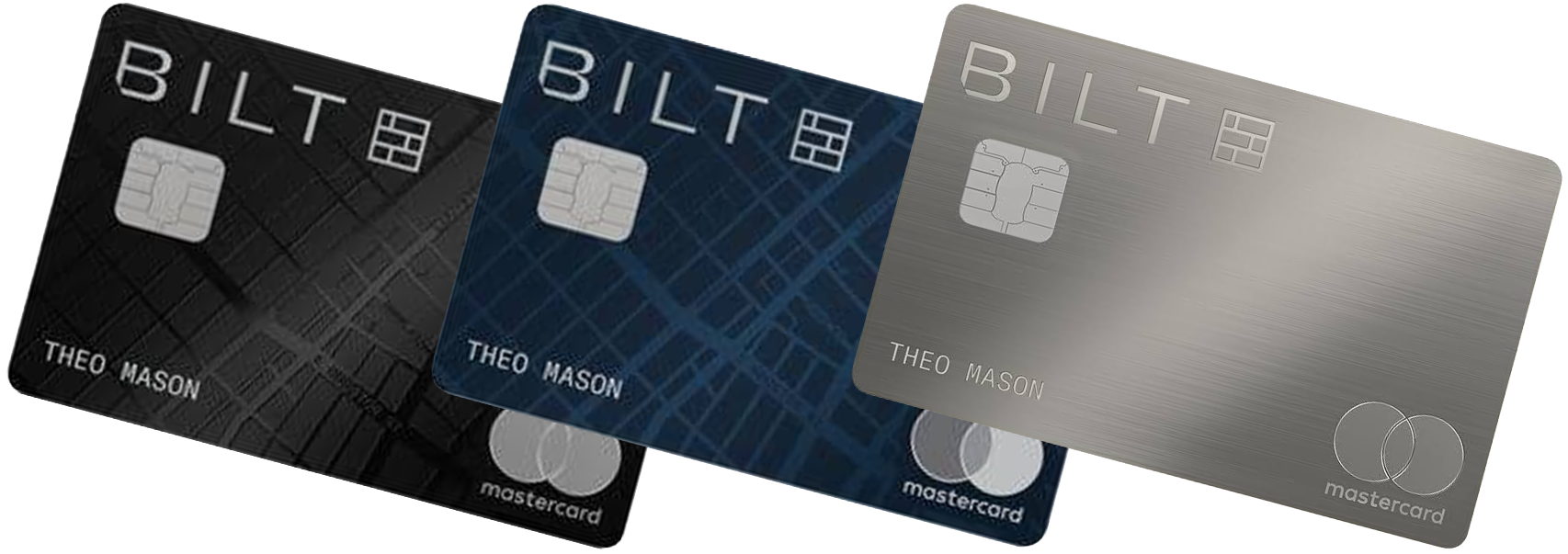
The Bilt Trifecta: What Paying Rent With Bilt Really Earns
TL;DR: Bilt's three cards let you pay rent or a mortgage by card with no transaction fee, which is real and worth having. The housing points are the part people overestimate. The ceiling is 1.25 points per housing dollar, you only approach it by routing everyday spending onto the card, and on the two cheaper cards that routing has a breakeven you can cross without noticing.
How the trifecta actually works
The lineup is Bilt Blue Card at $0, Bilt Obsidian Card at $95, and Bilt Palladium Card at $495. All three carry the same housing benefit: no transaction fee on rent or mortgage paid through Bilt, and up to 1.25 points per dollar on those payments.
Two numbers define the housing reward. The ceiling is 1.25x. The floor is 250 points per billing cycle, or 3,000 points a year, which you get regardless. Where you land between them depends on how much everyday spending you put on the Bilt card that cycle. More spend, higher multiplier. Bilt lays out both rewards paths in its Card 2.0 program overview.
That last sentence is the whole ballgame, because everyday spending routed to a Bilt card is spending not earning elsewhere.
The breakeven rule
Compare a Bilt Blue Card against a flat 2x card such as the Citi Double Cash Card, with rent still paid through Bilt.
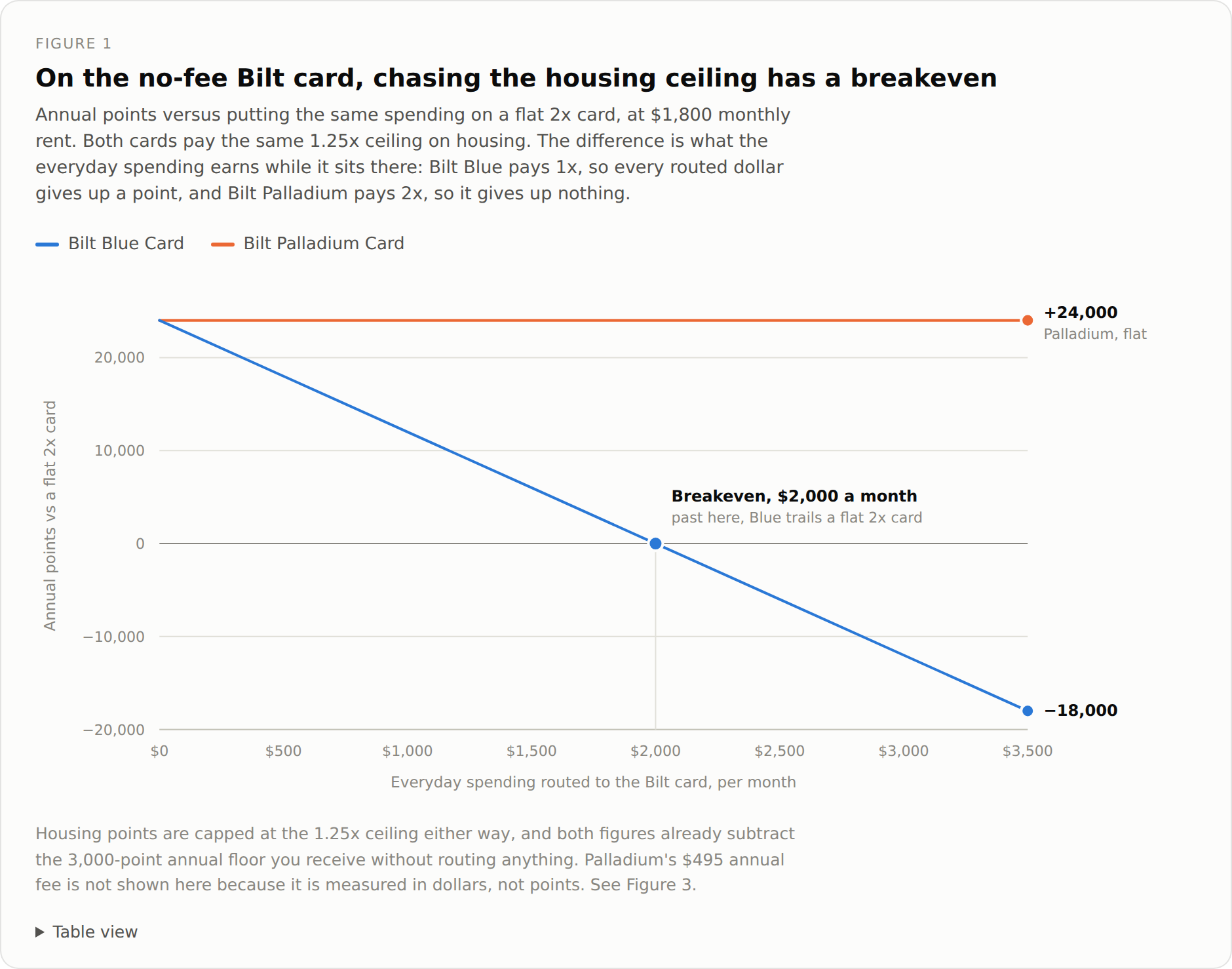
Blue earns 1 point per everyday dollar. The 2x card earns 2. So every dollar you move onto Blue to lift your housing multiplier costs you one point. Meanwhile the ceiling is only worth so much: at $1,800 rent, 1.25x on $21,600 of annual housing payments is 27,000 points, and 3,000 of those you would have received at the floor anyway. The most the ceiling can ever add is 24,000 points.
Burn one of those points per routed dollar and the arithmetic writes itself:
On the Bilt Blue Card, once your monthly everyday spending on the card passes 1.25 times your housing payment minus $250, you are behind a 2x card. Even at the perfect 1.25x rate.
- $1,800 rent: you fall behind past $2,000 a month
- $2,400 rent: you fall behind past $2,750 a month
- $3,200 mortgage: you fall behind past $3,750 a month
The trap is that the amount of spending needed to approach the ceiling and the amount that puts you underwater are close together. Bilt Obsidian Card behaves the same way on base spend, since it also earns 1x on everything outside its categories, and it charges $95.
Bilt Palladium Card is the exception, and it is not a small one. Palladium earns 2x on everyday spending, matching the baseline. Routing spend to it costs nothing, so the breakeven never arrives. Its net gain is the ceiling minus the floor, flat, no matter how much you put on the card: 24,000 points a year at $1,800 rent, 34,500 at $2,500.
Three myths worth retiring
Rent knocks out your welcome bonus. It does not. Housing payments are debited from a bank account rather than charged to your credit line, and Bilt's card offer terms exclude them from the Palladium card's $4,000 spending requirement. If you opened a card expecting rent to clear the minimum spend, it will not, at Bilt or anywhere else.
You earn 1.25x on rent. You earn up to 1.25x. The floor is 250 points a cycle, and everyone with a modest card habit sits closer to it than to the ceiling. Mortgage payers sit closest of all, because a mortgage is usually larger than a household's entire monthly card spend.
The fee waiver is worth hundreds a year. It is worth hundreds only against paying rent with a non-Bilt credit card, which costs 3% through the platform. Bilt publishes the fee on every rent payment method, and a bank transfer through Bilt is $1.95. Against what most people would otherwise do, a bank transfer, it saves very little. Value it against your real alternative.
The opportunity cost nobody prices
Chasing the ceiling means committing $20,000 to $30,000 a year of purchases to one card. That is capacity you are not pointing at welcome offers.
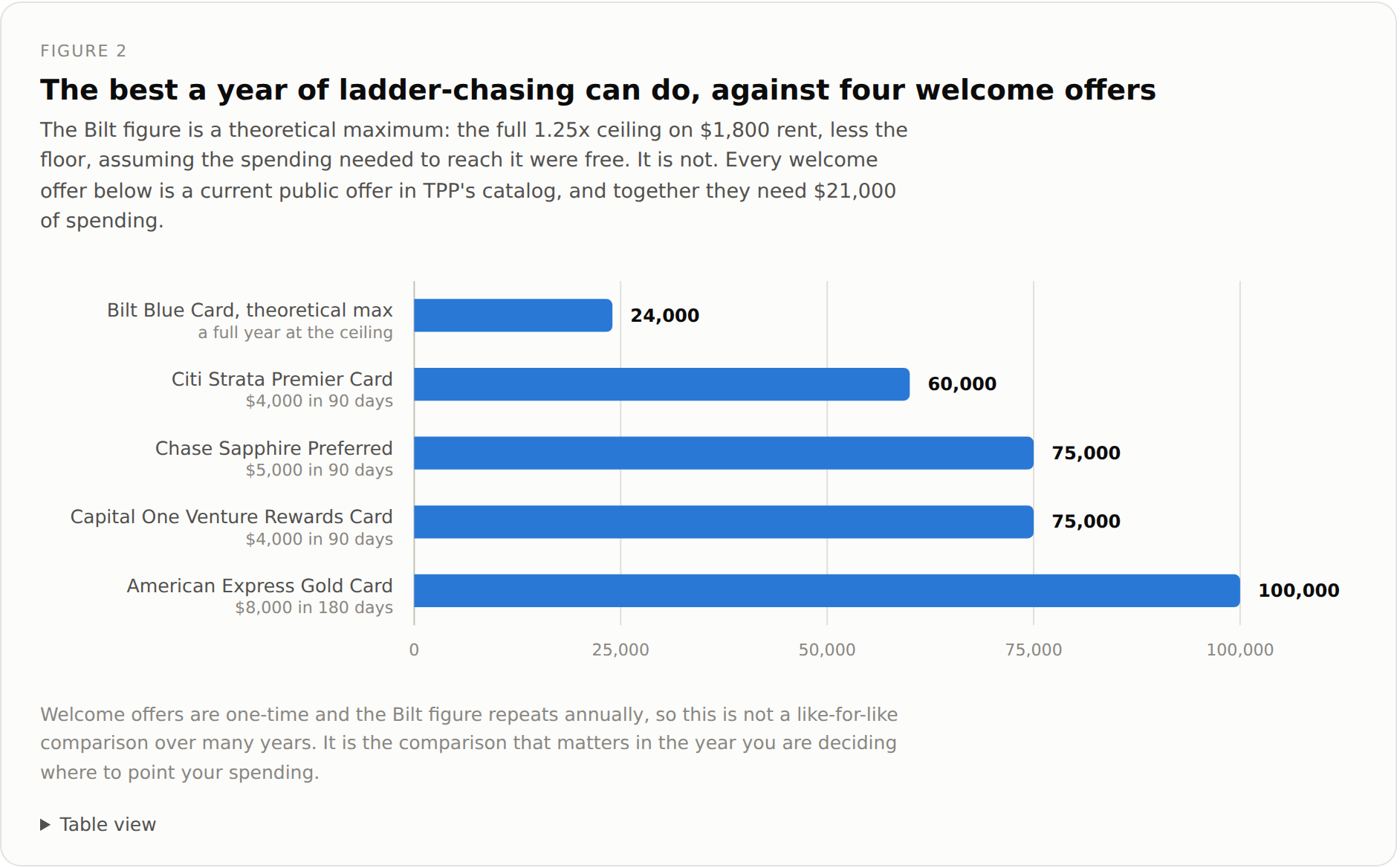
Four cards TPP tracks, $21,000 of combined minimum spend:
- Chase Sapphire Preferred: 75,000 points after $5,000 in 90 days
- Capital One Venture Rewards Card: 75,000 miles after $4,000 in 90 days
- Citi Strata Premier Card: 60,000 points after $4,000 in 90 days
- American Express Gold Card: 100,000 points after $8,000 in 180 days
That is 310,000 points and miles. The absolute best a Bilt Blue Card can do on $1,800 rent is 24,000 net points, and only if reaching the ceiling were free, which it is not. The Chase Sapphire Preferred bonus alone is more than three times the theoretical maximum. All four together are nearly 13 times it.
The accelerator, and who it helps
Obsidian and Palladium both carry a point accelerator: redeem $200 of Bilt Cash to earn 1 extra point per dollar on your next $5,000 of everyday spending, up to five times a calendar year. Palladium's $200 annual Bilt Cash funds exactly one use, turning $5,000 of spend from 2x into 3x, worth 5,000 extra points. That is a real perk, but note what it is: a reason to spend on the card, not a reason to chase the housing ladder.
Who this affects
If your card spending is well below your housing payment, the housing multiplier is close to noise. Carry the Bilt Blue Card for the fee-free payment and the floor, and send everyday spending wherever it earns most, including new-card minimums.
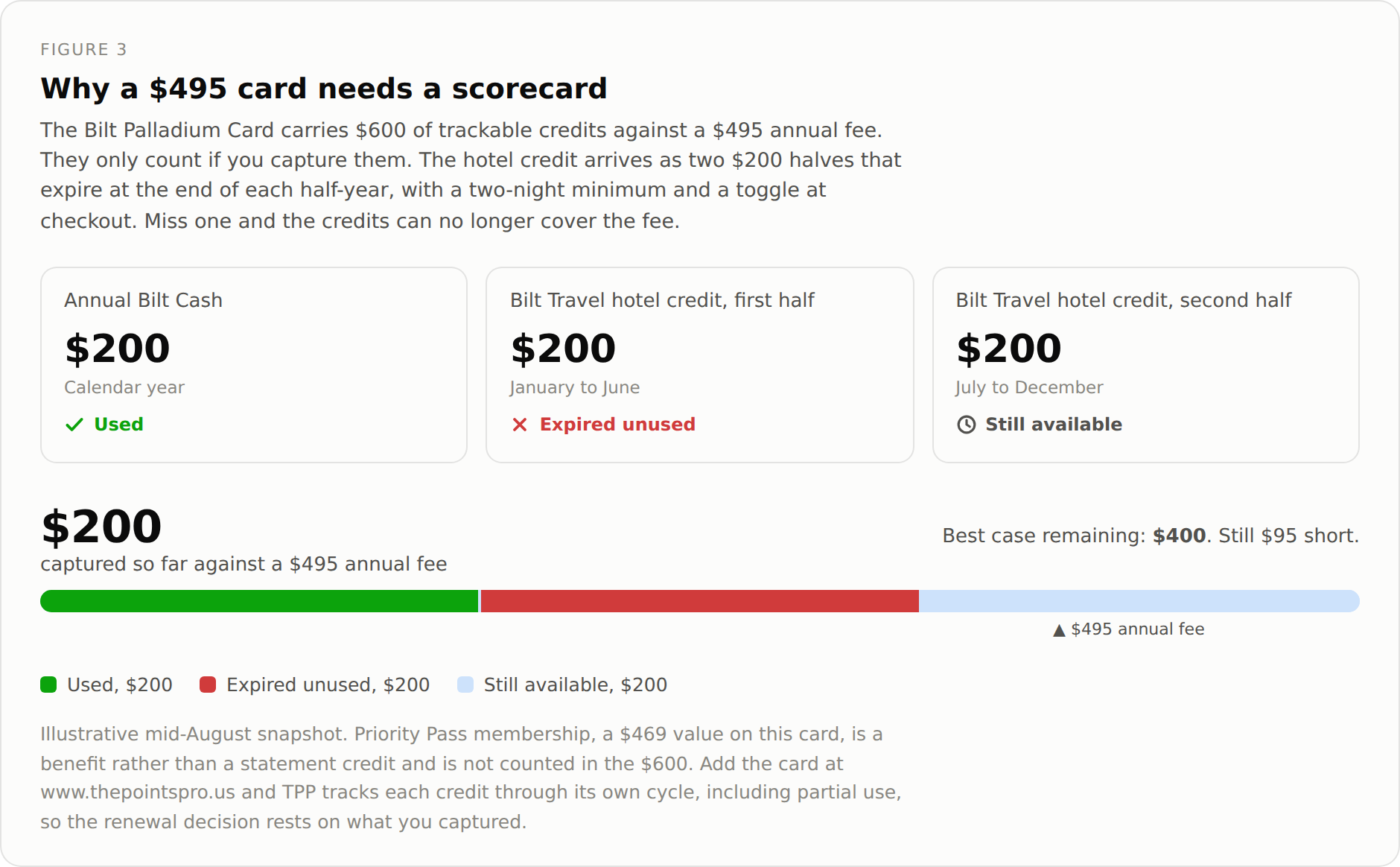
If your spending is high enough that you would approach the ceiling, do not do it on Blue or Obsidian. You would be paying for the ceiling with the spend you used to reach it. Bilt Palladium Card is the version that survives the math, because 2x everyday means the routing is free. Its $495 fee is covered by the $200 annual Bilt Cash and $400 in Bilt Travel hotel credits, if you use them, and those credits come in two halves with a two-night minimum that must be toggled on at checkout.
Obsidian's case rests on its 3x dining category, swappable to groceries once within 30 days of opening and then each January. Its housing math is Blue's, with a $95 fee attached.
What to do about it
- Work out your number: 1.25 times your monthly housing payment, minus $250. That is the most you should ever route to a Bilt Blue Card or Bilt Obsidian Card.
- If you are already past it, move the excess to a 2x card.
- Before committing spending to the ladder at all, list every welcome offer you are eligible for and clear those first.
- If you go Palladium, calendar the $200 Bilt Cash and both halves of the hotel credit. The fee only works if they get used.
That last step is worth automating, because $495 is a lot to pay on the assumption you will remember a two-night booking and a checkout toggle twice a year. Add the card to your wallet at thepointspro.us and TPP tracks each credit through its own cycle, including the case where you use part of one and not the rest. Before the annual fee posts again, you get a renewal review built on what you actually captured, not what you meant to. That is the honest way to answer the only question that matters on a $495 card: did the credits cover it this year, and will they next year.
The fine print
Housing payments do not count toward any card's minimum spend requirement. The multiplier is measured per billing cycle, so a light month drops you for that month. The Obsidian grocery option caps at $25,000 a year. Authorized users are free on Blue, $50 on Obsidian, and $95 on Palladium. Bilt Cash carries over only in part between calendar years, capped at $100 on Palladium. And the higher dining rates on all three cards apply at Bilt Neighborhood Dining partner restaurants, not at restaurants generally.
More changes like this one, as they happen: follow The Points Pro on Facebook.